News
Low Heart Rate Variability Causes: What Your Data Can Tell You
By Teemu Arina ·

Low heart rate variability causes include stress, poor sleep, chronic health conditions, and biological rhythms. To identify them, look beyond a single reading at patterns in how the autonomic nervous system responds to internal and external demands.
What low heart rate variability means
Heart rate variability (HRV) measures the variation in time between consecutive heartbeats. A healthy heart is adaptable, with variation regulated by the autonomic nervous system's sympathetic ("fight or flight") and parasympathetic ("rest and digest") branches.
Think of HRV as the heart's rhythm in a dance. If the dance is flexible and always changing, your heart is healthy and your autonomic nervous system is balanced. — Ilmo Strömberg, Biohacker Summit 2024
High HRV typically indicates a flexible nervous system that can switch between these states. A lower HRV reading may signal sympathetic dominance or insufficient parasympathetic recovery.
Reduced HRV can mark different health states. People experiencing clinical burnout often show lower HRV after prolonged stress (International journal of psychophysiology, 2016). In people with existing heart disease, low HRV is associated with increased cardiovascular events and mortality (Biological research for nursing, 2020).
Low heart rate variability causes to consider
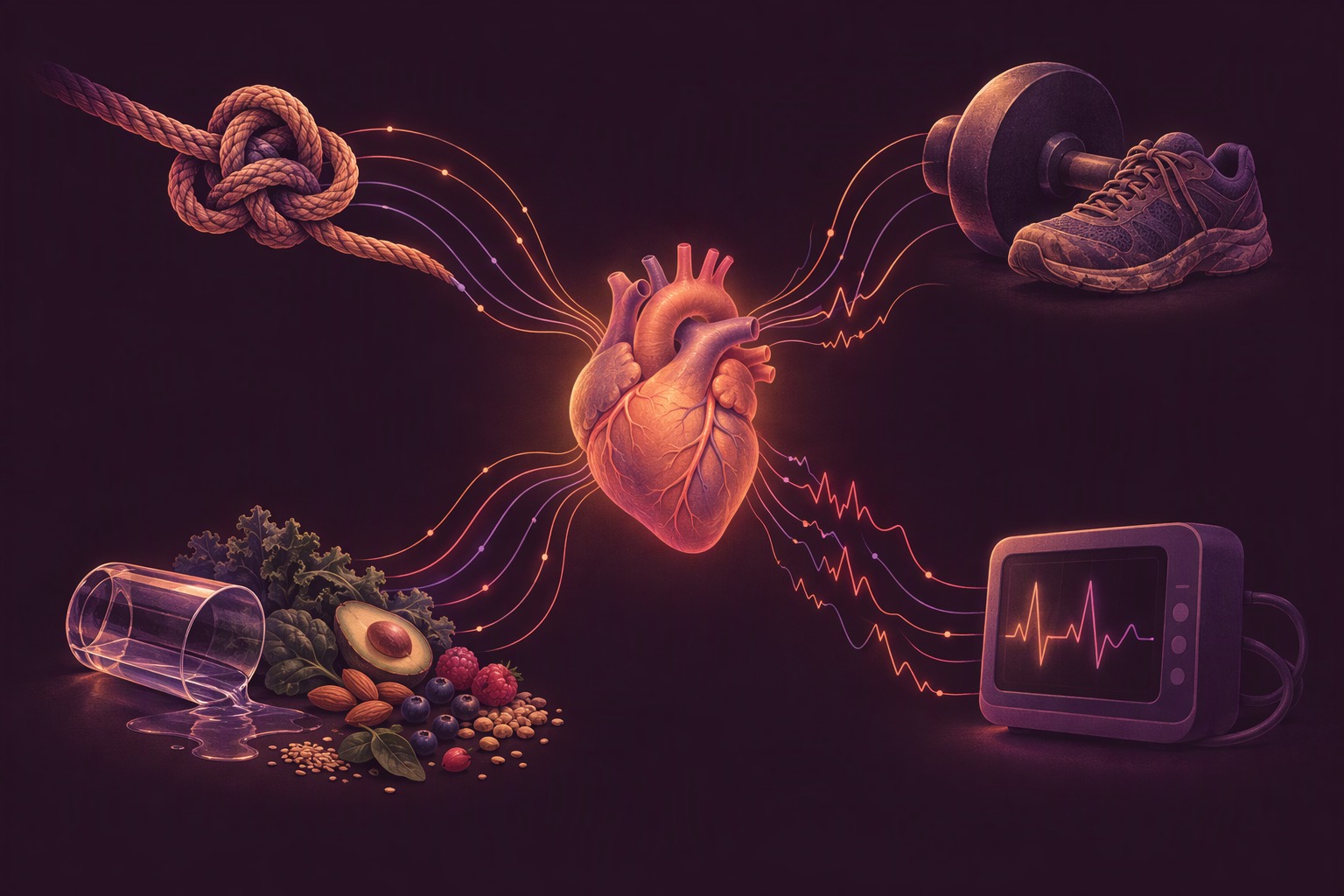
Stress, exertion, lifestyle habits, and health conditions converge around an anatomical heart.
Several factors may affect readings at once, so consider them together.
- Psychological stress: Acute or chronic psychosocial stress can suppress parasympathetic activity and reduce HRV (Psychiatry investigation, 2018).
- Physical recovery and training: Intense exertion can temporarily lower HRV as the body focuses on repair.
- Lifestyle habits: Nutrition, hydration, and alcohol can affect HRV.
- Chronic health conditions: Lower HRV is linked to higher risks of coronary heart disease and overall mortality in the general population (Circulation, 2000).
How sleep timing and circadian rhythms can shape readings
HRV and other physiological signals change across the 24-hour cycle.
Every function in our body has its optimum time in the twenty-four-hour cycle. — Hannu Kinnunen, Biohacker Summit 2017
Chronotypes, whether someone is a "morning person" or "evening person," are largely genetic. When social schedules conflict with a person's chronotype, "social jet lag" can disrupt sleep quality and autonomic balance.
Hannu Kinnunen noted that schedules opposing natural rhythms may affect recovery. Someone might stay up late to reclaim personal time despite a resting heart rate suggesting an earlier bedtime. This mismatch can impair sleep and affect wearable HRV readings.
Why one low reading may not tell the whole story
A sudden wearable reading can be concerning, but one data point is rarely diagnostic.
One thing I have learned with different wearables, that you should always be a little bit skeptical when you're looking at the numbers. — Ilmo Strömberg, Biohacker Summit 2024
Biomarkers fluctuate with factors such as food, movement, and nervousness. Ilmo Strömberg, who has tracked over 300 biomarkers, uses data to explore his body's responses to specific situations, including public-speaking stress.
Compare readings with your personal baseline, sleep quality, and training load rather than reacting to one low value. Find out more in our guide to Understanding Your Normal Rate for Heart Rate and HRV.
How to track HRV and test possible causes
"N=1" experimentation means changing one variable at a time to see how it affects your results.
- Establish a baseline: Use a wearable or free smartphone app to identify your typical range.
- Isolate variables: If evening caffeine may affect recovery, stop it for a week and track the trend.
- Correlate data: Compare HRV with sleep duration, activity, and subjective measures such as mood or energy.
- Monitor trends, not outliers: Look at weekly or monthly averages rather than daily spikes or dips.
This approach can show which adjustments, such as better light hygiene or meal timing, affect your physiology.
When a low HRV reading deserves medical advice
HRV tracking can inform self-optimization. It cannot replace medical assessment. Low HRV is associated with increased risk of all-cause death and cardiovascular events in certain populations (Biological research for nursing, 2020); a persistent decline may warrant further investigation.
Consult a healthcare professional if a significant decrease persists despite rest or accompanies chest pain, palpitations, or extreme fatigue. If managing a health condition, compare wearable data with clinical tests.
FAQ
What are the most common causes of low heart rate variability?
Common causes include psychological stress, insufficient sleep, intense physical overtraining, and chronic health conditions. Alcohol and poor nutrition can also contribute.
Can stress or poor sleep lower HRV?
Yes. Stress can suppress the parasympathetic nervous system, while disrupted sleep or circadian misalignment can impair recovery and lower readings.
Why does HRV change from day to day?
HRV responds to stimuli such as meals, exercise intensity, hydration, and emotional state. These fluctuations are a normal part of how the autonomic nervous system manages the body's internal and external environment.
How can you tell whether a low HRV reading is meaningful?
Compare it with your personal baseline and look for patterns over days or weeks, not a single reading. If it remains below your average despite adequate rest, consider lifestyle changes or professional advice.
Sources
- Low heart rate variability in patients with clinical burnout. International journal of psychophysiology (2016).
- Low heart rate variability in a 2-minute rhythm strip predicts risk of coronary heart disease and mortality from several causes: the ARIC Study. Circulation (2000).
- Stress and Heart Rate Variability: A Meta-Analysis and Review of the Literature. Psychiatry investigation (2018).
- Heart Rate Variability and Risk of All-Cause Death and Cardiovascular Events in Patients With Cardiovascular Disease: A Meta-Analysis of Cohort Studies. Biological research for nursing (2020).
- Analysis of Heart Rate Variability and Implication of Different Factors on Heart Rate Variability. Current cardiology reviews (2021).
- Insights from the study of heart rate variability. Annual review of medicine (1999).
- Talk: “DEFINING CHRONOTYPES WITH BIOSIGNALS - A LOOK INTO DATA”, Hannu Kinnunen, Biohacker Summit 2017 Helsinki (2017). Session Page
- Talk: “Mastering the Quantified Self & N=1 Experiments”, Ilmo Strömberg, Biohacker Summit 2024 Helsinki (2024). Speaker Page
This article is for general information and is not medical advice.
In this story

Comments
Loading comments…