News
Sauna and Heart Health: Using Heat Stress to Improve Resilience
By Teemu Arina ·

Sauna and heart health are connected through the body's response to heat: a session raises heart rate and can temporarily lower blood pressure, while repeated use may affect some cardiovascular measures. The practical question is how to use heat in a measured way and what the evidence says about longer-term effects and HRV.
The principle of hormetic stress
Hormesis describes how a manageable, temporary stressor may prompt adaptation, while too much stress can be harmful. At Biohacker Summit 2017 Helsinki, Teemu Arina, Olli Sovijärvi and Jaakko Halmetoja discussed using sauna and cold exposure in moderation and allowing time for recovery.
A sauna session involves deliberate exposure followed by a return to ordinary conditions. The manageable dose varies; feeling depleted does not mean a session was more effective. In the same 2017 talk, Arina described stress as a skill practised by finding balance between activation and restorative states. This is a framework for thinking about heat, not proof of a particular health outcome.
A review of sauna bathing describes possible cardiovascular benefits and mechanisms, including changes in blood pressure and vascular function. It does not establish that sauna prevents disease for every user. Its findings are a reason for further study, not a promise of protection (review of cardiovascular and other sauna benefits).
How sauna use impacts sauna and heart health
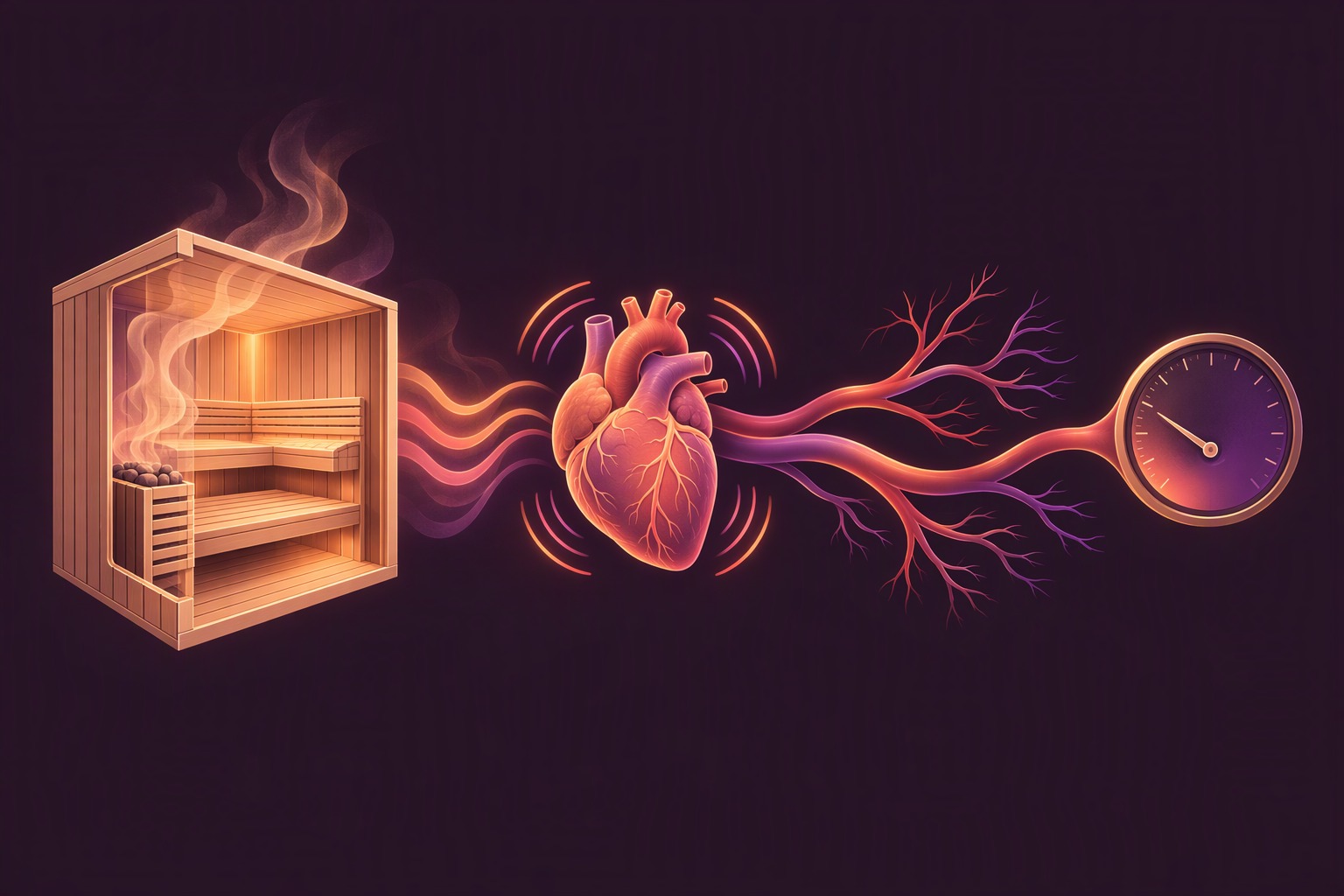
The illustration links sauna heat with a faster heartbeat and a lower blood-pressure reading.
Heat places an immediate demand on the cardiovascular system. A meta-analysis of 16 papers found increases in body temperature and heart rate after sauna exposure, alongside average reductions in systolic and diastolic blood pressure during the periods studied. These short-term responses do not by themselves show that long-term cardiovascular risk has changed (meta-analysis of acute and short-term cardiovascular effects).
In one experiment, 102 participants with at least one cardiovascular risk factor had lower average blood pressure and arterial stiffness measurements after a single 30-minute session at 73°C. Blood pressure remained lower than before the session after a further 30 minutes of recovery. These immediate results apply to the group and protocol studied, not necessarily to everyone (study of acute cardiovascular effects).
Repeated use may affect other measures, but evidence varies by population and study design. A small randomised trial assigned people with low physical activity and at least one cardiovascular risk factor to exercise, exercise followed by sauna, or control. After eight weeks, the exercise-plus-sauna group had a greater reduction in systolic blood pressure and lower total cholesterol than the exercise-only group; both exercise groups improved cardiorespiratory fitness relative to control. The trial tested sauna alongside exercise, not instead of it (randomised trial of sauna alongside exercise).
A review describes associations between regular sauna bathing and lower risk of some vascular outcomes, and discusses possible changes in vascular function, arterial stiffness and blood pressure. Association does not establish that sauna caused the outcome, since regular sauna users may differ in other ways. The review provides context, while direct trial evidence remains limited to the populations and protocols studied (review of cardiovascular and other sauna benefits).
Connecting heat stress to heart rate variability (HRV)
HRV is variation in the time between heartbeats. It can offer a window onto autonomic regulation, but a wearable reading is not a direct measure of cardiovascular health or an explanation for how someone feels. See what HRV can and can't tell you.
At Biohacker Summit 2017 Helsinki, Teemu Arina, Olli Sovijärvi and Jaakko Halmetoja discussed balancing the sympathetic and parasympathetic sides of the autonomic nervous system, and described slow breathing as a way to move towards a restorative state. They did not claim sauna improves HRV, and the cited papers do not establish that it does. Evidence of heat's effects on heart rate and blood pressure is not proof of an HRV benefit.
For anyone tracking HRV or searching for "hrv heart rate variability," an acute response to sauna does not show that baseline HRV has improved. Readings are more useful over time and under comparable conditions than as a verdict based on one post-sauna value. See also how normal heart rate and HRV vary.
Sauna is one stressor; breathing, rest and returning to baseline also matter. Sovijärvi described moving between an ice bath, a warm bath and sauna before returning to cold exposure. This was his personal pre-talk routine, not a validated protocol or recommendation. Consider the stress-and-recovery cycle; greater intensity does not necessarily bring greater benefit.
Practical protocols for cardiovascular resilience
Research has not established one ideal sauna schedule. Studies used 30 minutes at 73°C in a single-session experiment, 15 minutes after exercise in a trial, and, in a heart-failure review, infrared sauna at 60°C for 15 minutes followed by 30 minutes of rest, five times a week for two to four weeks. These are study methods, not universal prescriptions.
Treat sauna as an optional addition to a health routine, not its foundation. The 2022 trial studied sauna alongside guideline-based exercise; its findings do not support replacing exercise with heat. A conservative application of hormesis is to choose a manageable exposure, allow recovery and avoid extending a session to chase a stronger response. Individual circumstances matter, and studies do not identify one best duration or temperature for everyone.
A simple record of session length, how it felt and whether recovery was comfortable may help reveal personal patterns, though it is not a clinical test. If using a wearable, compare readings taken at similar times and under similar conditions rather than drawing conclusions from one session. See HRV patterns by age.
Sovijärvi's account of combining cold, warm water and sauna illustrated one person's use of contrasting exposures; it is not evidence that contrast bathing improves heart outcomes or a template to copy. A person can try sauna alone, note the response and avoid adding multiple stressors at once.
The HOLOLIFE Summit 2027 takes place in Amsterdam on 13–14 November 2027. Find details at the event page.
Safety considerations for heat exposure
The meta-analysis found a rise in heart rate and reductions in blood pressure after sauna exposure; the experimental study also observed changes in blood-based measures. These short-term shifts may matter differently depending on a person's health and do not mean sauna is safe or beneficial for everyone.
People with heart conditions, blood pressure concerns or questions about heat and their care should consult a qualified health professional before starting or changing sauna use. A systematic review of sauna and heart failure found potential short-term benefits, but only infrared sauna studies met its criteria, and evidence strength ranged from moderate to insufficient. Its protocol is not a general recommendation for people with heart failure (systematic review of sauna and heart failure).
The evidence does not justify treating sauna as protection against sudden cardiac death. A review found the evidence uncertain despite observational associations between regular sauna bathing and some cardiovascular outcomes (review of sauna and sudden cardiac death). Sauna is not a substitute for medical care or established prevention strategies.
Keep exposure moderate, allow recovery and stop rather than push through if feeling unwell. Anyone with a diagnosis or symptoms should discuss heat exposure with their clinician; studies do not cover every condition, medication or individual response.
FAQ
How often should I use a sauna for heart health?
No single frequency has been established for everyone. Studies tested different schedules, but these are not universal prescriptions; personal health and tolerance matter.
Is sauna use safe for people with existing heart conditions?
The evidence is too limited to say it is safe for every heart condition. A review found possible short-term benefits in heart failure, but included only infrared sauna studies and evidence of varying strength; people with a diagnosed condition should ask their clinician.
Does sauna use improve heart rate variability?
The papers cited here do not establish that sauna improves HRV. Changes in heart rate, blood pressure and vascular function do not demonstrate a sustained HRV change.
What is the best temperature for cardiovascular benefits?
Studies do not identify one best temperature for everyone. A single-session study used 73°C, while a heart-failure review included infrared sauna studies at 60°C; these are study conditions, not recommendations.
Sources
- Cardiovascular and Other Health Benefits of Sauna Bathing: A Review of the Evidence
- Acute and short-term efficacy of sauna treatment on cardiovascular function: A meta-analysis
- Acute effects of sauna bathing on cardiovascular function
- Effects of regular sauna bathing in conjunction with exercise on cardiovascular function: a multi-arm, randomized controlled trial
- Effects of sauna bath on heart failure: A systematic review and meta-analysis
- Is sauna bathing protective of sudden cardiac death? A review of the evidence
- Talk: “BIOHACKING STRESS FOR LONGEVITY AND HEALTH”, Teemu Arina, Olli Sovijärvi and Jaakko Halmetoja, Biohacker Summit 2017 Helsinki (2017).
This article is for general information and is not medical advice.
In this story



Comments
Loading comments…